
Issue virtual cards for vendors, payroll, and subscriptions.
Set the spend limit, lock the merchant, send it. The cardholder gets a Visa card quickly. You track every transaction from one dashboard.
- Issue quickly
- Apple & Google Wallet
- Bulk via Excel or API
Independently audited and certified









VirtualCardMaker.com, powered by Zil Money, is a financial technology company, not a bank. Banking and money movement services are provided through partner financial institutions and licensed service providers. FDIC insurance coverage applies only to eligible deposit products and accounts, and is subject to applicable terms, conditions, limitations, and requirements. Additional information regarding partner institutions, products, and services is available in the applicable terms and agreements.
Give every line of spend its own card.
One shared number turns every statement into an investigation: the charge is there, the reason is not. Issue a card per vendor, per hire, per trip and the answer arrives with the transaction — who spent it, what for, and against which limit.
thru11/30
thru11/30
thru11/30
thru11/30
thru11/30
One card · one number · one shared trail
$11,500 / month, capped once for everyoneIts own cap
A limit and interval per card, enforced at authorisation — not a policy someone has to remember.
Its own name
The vendor or the person is on the card, so the statement line needs no chasing to explain.
Its own off switch
Cancel one the day the work ends. The other four keep running, untouched.
Month-end takes minutes when the work was done at issue time.
Every decision that usually gets made in arrears — what this was for, whether it was approved, whether it was too much — is made once, when the card is created. The close is then a read of what happened, not a reconstruction of it.
- The day someone leaves
Offboarding is one click, not a fire drill
Kill the leaver’s card or the ex-vendor’s card and nothing else moves. No reissue, no new numbers to circulate, no fortnight of declined payments while the team catches up.
- Every time a charge posts
The coding is done before the charge lands
A charge arrives on the card that was issued for that vendor, that project, that person — so the category, the owner, and the cost centre come with it. Nobody tags anything after the fact.
- At renewal
The price rise declines instead of clearing
A renewal that quietly doubles hits the card’s cap and stops there. You find out at the attempt, while you can still negotiate — not on next month’s statement, after it has been paid.
- If a number ever leaks
A card can only be spent where it was meant to
Merchant, country, and time restrictions ride on the card itself, so a leaked number is worth nothing anywhere else — and the blast radius of any one card is that one card.
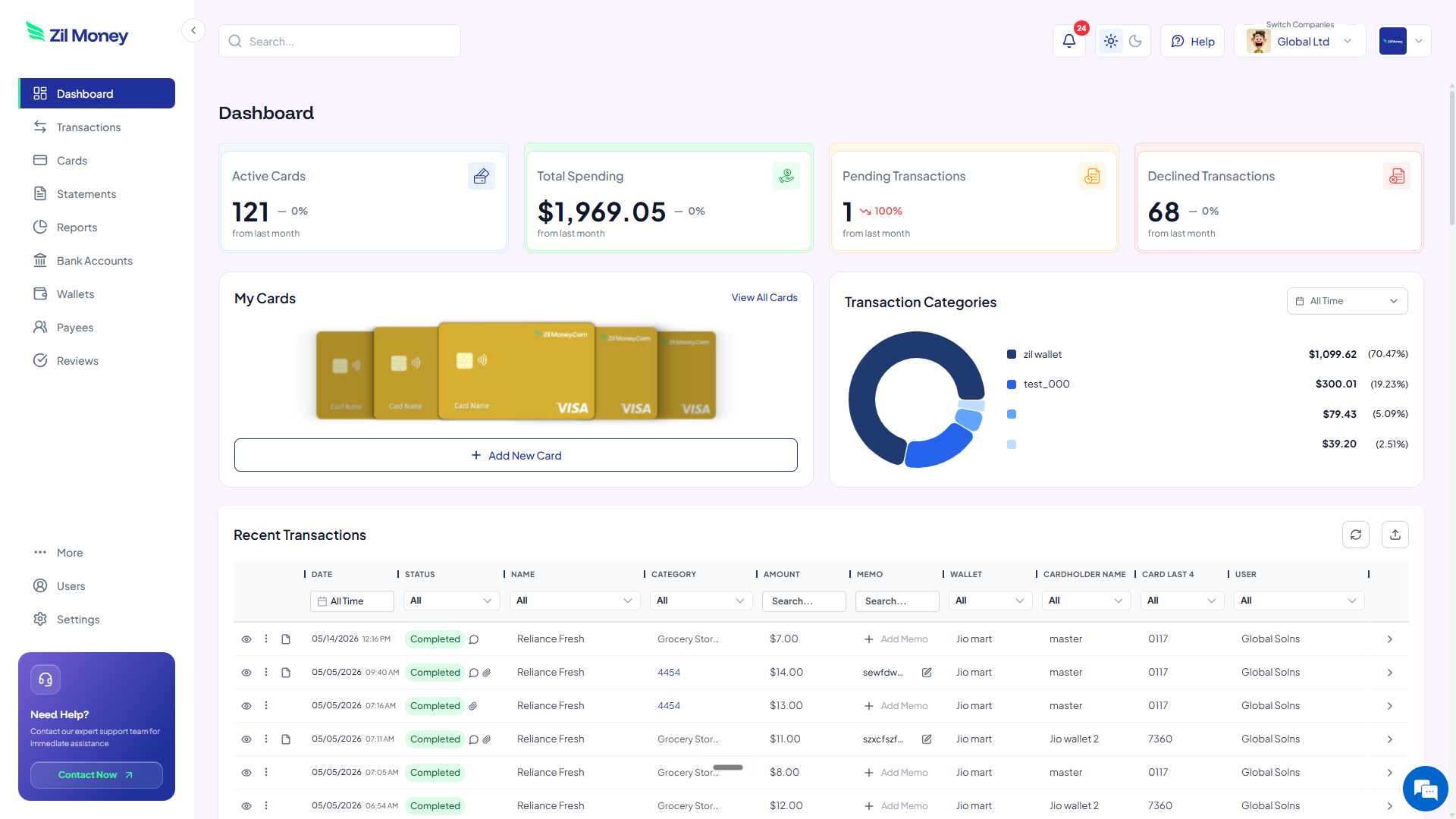
Everything the card touches, in one place.
Issuing, controls, the ledger, review, and the rules that file it all — four screens of one product, not four products you have to reconcile with each other.
The rules are set before the card exists.
Every card needs a limit and an interval. Merchant, country, and time restrictions are yours to add. All four are checked by the network at authorisation, so an over-limit charge is declined rather than discovered.
See every control- Spending limitRequired$5,000 / monthResets on the 1st. Anything above it is declined at the terminal.
- Merchant categoryOptionalSoftware & SaaS · 5734The number is useless at any merchant outside this category.
- CountryOptionalUnited StatesAn attempt from anywhere else never reaches your balance.
- Time windowOptionalWeekdays, 08:00–20:00Out-of-hours charges are the ones nobody is watching for.
Issued, spent, reconciled, retired.
A card here has a beginning and an end, and both are yours to set. Nothing outlives the thing it was issued for.
- 01
Issue it
Under a minuteChoose the type, set the ceiling and the interval, and lock it to a merchant if that is what the job needs. It draws on your funded wallet, so it can never spend money you have not put there.
- 02
Send it
Instant, to their phoneThe cardholder has it on their phone before the meeting ends, ready for Apple Wallet or Google Wallet where supported. No plastic in the post, no number read out over a call.
- 03
Track it
As it happensEvery authorisation lands against the card that made it — vendor, project, and owner already attached. Attach the receipt, assign a reviewer, and it is closed.
- 04
End it
One click, no falloutWhen the trip is over or the contract ends, cancel the card. Its rules retire with it and every other card carries on untouched.
Wallet balance
$47,586.32
thru11/30
- USUSPSShipping · 2210$144
- AMAmazon Web SvcsEng · 4471$1,284
- DEDelta Air LinesTravel · 3318$612
thru11/30
A policy nobody has to remember.
A written spending policy only works if every person recalls it, at the moment of paying, months after reading it. Put the same rules on the card and they stop being a request. They are checked on the charge itself, by the network, every time.
And they have the card’s lifespan: change one card and no other card notices; cancel it and its rules retire with it. Nothing to rescind, nothing left behind in a document that outlives the project.
Build one in Card StudioSomeone goes over the cap
Policy:Found when the month closes
Declined at the terminal
Spending outside the approved list
Policy:A slide in an onboarding deck
Locked to the card’s category
A contractor finishes up
Policy:An email asking them to stop
Cancel the card; access ends
An exception is granted
Policy:A thread nobody finds later
A card with its own limit and record
A card shaped like the spend it is for.
A subscription wants a card that reloads and never leaves one merchant. A contractor wants a card with their name on it. A rebate wants a card that works once and expires. Same wallet, same controls, same ledger — different card.
thru11/30
Virtual Visa card
A 16-digit number issued in seconds, locked to one vendor and one monthly ceiling. Spend it anywhere Visa is accepted.
- Reloadable
- Merchant-locked
thru11/30
Expense card
A reloadable team card with a limit per project. Freeze it, raise the cap, or thaw it again in one tap.
- Per-project limits
- Freeze and unfreeze
thru11/30
Vendor card
One card per supplier, restricted to that merchant. A renewal that jumps its price declines instead of clearing.
- One vendor only
- Stops surprise renewals
thru11/30
Employee card
The cardholder’s own name on the card, their own limit, and a reviewer on anything above it.
- Named holder
- Approval workflow
thru11/30
Payroll card
Pay contractors and staff without bank details. Fund the run in one upload and the cards go out the same day.
- Bulk issue
- Same-day funding
thru11/30
Gift card
Issued in bulk from a spreadsheet, spent once, and expired on the date you set. Virtual or printed.
- One-time or reloadable
- Virtual or physical
From signup to first swipe, in three steps.
Full walkthrough- 01Once, at setup
Fund a wallet
Connect a bank account, verify it by micro-deposit, and top up by ACH or wire. The wallet holds the balance; cards draw from it, so nothing can be spent that you have not funded.
Run several wallets side by side — one per entity, department, or client.
- 02Under a minute, per card
Issue the card
Pick the type, name the cardholder, and set the limit and interval. Add merchant, country, or time restrictions to the ones that need them.
Bulk issue from a spreadsheet when it is a payroll run or a rebate batch.
- 03Ongoing, then done
Track and close it out
Charges post against the card that made them, already attributed. Attach receipts, assign a reviewer, and cancel the card the day the work ends.
Cancelling one card retires its rules and leaves every other card running.
What is the shared card already costing you?
Three leaks show up on almost every shared card: software nobody uses any more, spend that would not have been approved, and the hours it takes to work out which was which. Move the sliders for your numbers. Nothing you enter leaves your browser.
Three companies, same three leaks
A ten-person startup
One card, a handful of tools. The leak is small in cash terms — and it is nearly all software nobody cancelled.
Anyone who buys on the company card
1–500
SaaS tools, ad platforms, suppliers
1–300
Total across every card today
$2,000–$500,000
Chasing receipts and coding charges
1–120
Estimated annual recovery
$33,396
$2,783 a month — about 3.3% of what you put through cards.
- Dormant subscriptions
- $3,720
- Out-of-policy spend caught earlier
- $21,420
- Close time returned
- $8,256
5 of 38 vendors, at $62/mo
2.1% of card spend, declined at the terminal
172 hrs a year, at $48/hr
Estimates only, based on commonly cited ranges for unused software, out-of-policy spend, and month-end effort. Your results depend on how you use the product.
Written for whoever has to run this.
Not thought-leadership. Specific situations — a contract amount that changed, an employee who left with the SaaS still billing — and what to do about each.
The questions that decide it.
Cost, speed, physical cards, controls, wallets, and the API — answered plainly, with the actual numbers where there are any.
You fund the wallet with the amount you want your cards to spend, and cards are issued on demand from that balance. Physical cards add a USPS shipping fee, currently $12 for standard delivery inside the United States.
A spending limit with a limit interval, plus three optional restriction categories: geographic, merchant, and time. Each defaults to no restriction, so you apply only what a given card needs.
Still deciding? Ask us the awkward one — pricing, limits, or whether it fits how you already work.
Talk to the teamThe next vendor gets its own Visa card.
Not the shared one. Its own number, its own ceiling, its own line in the ledger.
No charge to open an account, and no minimum. You fund the wallet with what you intend to spend, and cards draw from that.
Create the account
2 min
Email, company name, password.
Verify the business
Same day, usually
Standard KYB checks on the entity and its owners.
Fund the wallet
1–2 days to clear
Connect a bank account and top up by ACH or wire.
Issue the card
Under a minute
Pick the type, set the limit, add restrictions, send it.
VirtualCardMaker.com, powered by Zil Money, is a financial technology company, not a bank. Banking and money movement services are provided through partner financial institutions and licensed service providers. FDIC insurance coverage applies only to eligible deposit products and accounts, and is subject to applicable terms, conditions, limitations, and requirements. Additional information regarding partner institutions, products, and services is available in the applicable terms and agreements.