
Virtual cards for import and export businesses, one card per order.
Paying international suppliers by wire means sharing your real bank details with every vendor, on every transaction, with no way to recover if the payment goes wrong. Issue a wallet-funded virtual Visa per purchase order, cap it to the agreed amount, and email it to the supplier. They get paid with a Visa charge, your account stays private, and each order reconciles to a single card instead of a batch wire statement.










A wire sends your bank details to every supplier, in every country, every time.
Import and export businesses live on the gap between purchase order and payment, and the wire is the part of it you cannot take back.
- Your account number travels with the money. Every supplier, on every transaction, receives the details a wire has to carry.
- A supplier breach becomes your breach. If their system is compromised, your account number is in it.
- A wire is hard to reverse. If the payment needs to come back, you are in a negotiation that may not end in your favour.
- Nothing caps the charge. A raw-material surcharge, a currency adjustment, or a plain error clears because there is no ceiling on the rail.
- Reconciliation is batch matching. A shared wire account produces a statement you then map back to individual purchase orders by hand.
One card per purchase order, capped to the agreed amount.
Issue a wallet-funded virtual Visa per purchase order, cap it to the PO amount, and email it to the supplier’s payment contact. The rail changes; the supplier relationship does not.
- PO-matched cap. Set the cap to the purchase order amount. An overcharge is declined at authorization, before the money leaves.
- Your account stays private. The supplier sees a Visa number only. Your real account details are never shared.
- No integration on their side. They enter the card in their terminal or online portal exactly as they would any Visa payment. It works anywhere Visa is accepted globally.
- Supplier lock where supported. Lock the card to the supplier’s merchant or category as a second layer on top of the cap.
- A PO label. Name the card with the PO number so every charge ties to one order at reconciliation. One card, one charge, one PO, one receipt.
- Cancel before a dispute. Hold a payment on a goods inspection dispute by cancelling the card before the supplier can charge it.
Four steps from a purchase order to a matched payment.
- 01
Make a card.
Issue a wallet-funded Visa for one purchase order and set the cap to the PO amount.
- 02
Label it.
Name the card with the PO number, and lock it to the supplier’s merchant or category where supported.
- 03
Email it to the supplier.
Their payment contact charges the card as they would any Visa. A charge matching the PO clears.
- 04
Match one to one.
Every card carries one charge, one PO, and one receipt, so month-end is matching a column rather than reconstructing a narrative.
Every order reconciles to a single card.
Watch each charge post under the PO it belongs to, with its receipt attached. Issue, freeze, top up, or close any card from the same screen. Freight moving on your own trucks? See virtual cards for logistics companies.
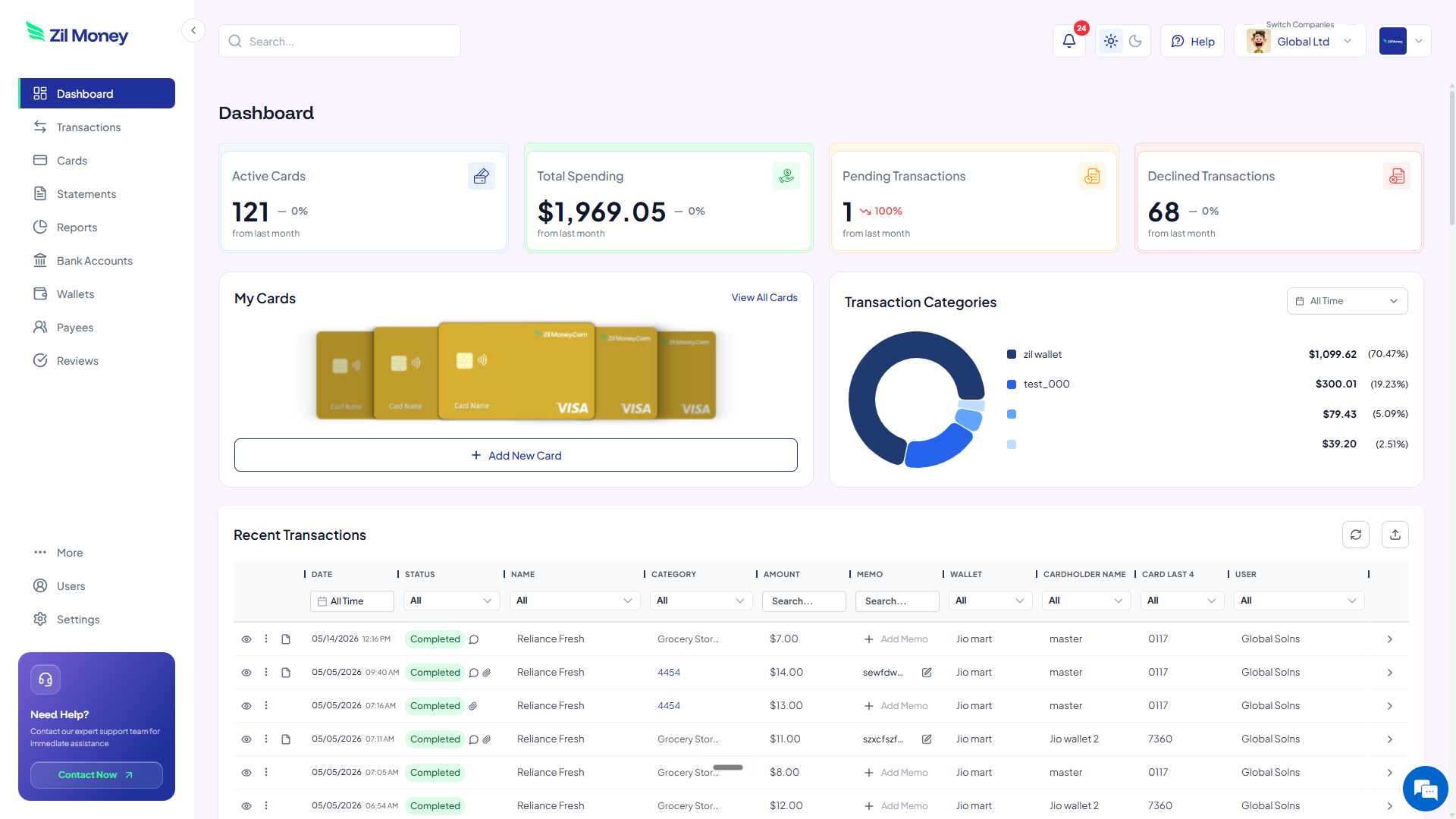
Live dashboard
Active cards, spend by purchase order, declined attempts, every charge as it happens.
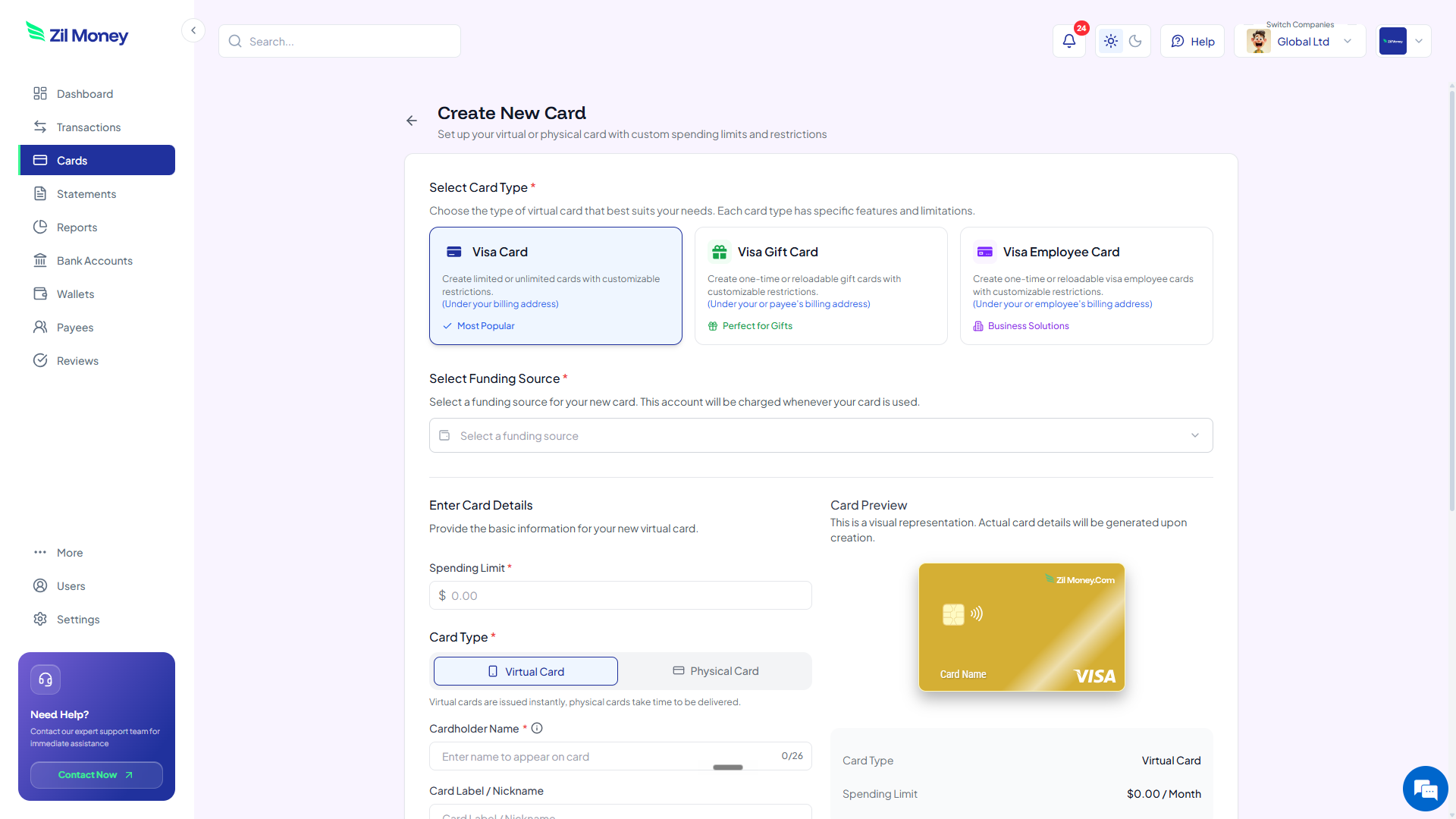
Issue a PO card
Pick the card type, set the cap to the PO amount, choose virtual or physical, email it to the supplier.
What you can set on every purchase order card.
ControlWhat you setWhy it matters
Spend limit
The purchase order amountA surcharge, currency adjustment, or error above the cap is declined at authorization.
Store categories
Supplier merchant or category, where supportedA second layer on top of the cap, based on supported controls.
Time window
Start and end datesThe card matches the order rather than staying live after it ships.
Cardholder name
The PO numberEvery charge ties to one order at reconciliation.
One-time or reusable
ToggleA single order, or a tranche card per instalment.
Three ways importers use virtual cards.
- One card per PO
Cap the card to the order, label it with the PO number, and the match at reconciliation is automatic rather than manual.
- Partial payment / a card per tranche
A supplier charging part now and the rest later gets a new card for each tranche, so the structure matches how the payment actually works.
- Inspection dispute / hold the payment
A goods inspection dispute means you cancel the card before the supplier can charge it, rather than chasing a wire that has already gone.
Two cautions worth building into the workflow. The supplier lock depends on how their acquirer codes the transaction and may not always fire, so the cap set to the PO amount is the primary control and the lock is a backup layer. And do not cancel the card while a charge is in process — cancelling does not reverse a pending authorization, so reconcile against settled activity.
Common questions.
Will international suppliers accept a virtual Visa card?
Many do. The card is a Visa and works at any merchant that accepts Visa. Some suppliers prefer wire or bank transfer; for those, keep the wire and use a card for suppliers willing to accept Visa.
Does a virtual card protect my bank account from exposure?
Yes. The supplier sees a Visa card number, not your bank account details, routing number, or wallet balance. A compromised card number is cancelled and replaced; a compromised bank account is a different problem.
How does reconciliation work across many purchase orders?
Issue one card per PO and label each card with the PO number. At reconciliation, each card has one charge matching one PO, so you match them 1:1 instead of tracing a wire batch back to individual orders.
Can I issue cards for USD payments from an Indian business?
Yes. The virtual cards are Visa and accepted in USD globally. Fund the Zil Money wallet and issue Visa cards for international supplier payments from that balance.
What if a supplier tries to charge more than the PO amount?
The charge is declined at authorization if it exceeds the spend cap. Nothing lands until you review and decide whether to reload the card at the new amount.
Can I issue cards in bulk for a large import run?
Yes. Upload a spreadsheet with each PO's amount and label and issue cards for all orders in one run. Each card still carries its own cap and label.
Related setups.
- Industries
Virtual cards for staffing agencies, one card per placement.
Staffing agencies carry the cost of reimbursing placed workers for job-related expenses, including uniforms, tools, and travel to the client site, while the billing cycle lags by w
4 min read - Industries
Virtual cards for real estate: one card per property, every dollar tracked.
A contractor who has your business card number can keep charging after the job ends. A contractor who has a virtual card capped to the renovation budget cannot. Virtual cards for r
6 min read - Industries
Virtual cards for logistics companies, one card per driver.
Petty cash and shared cards are how fuel receipts go missing and mileage claims get inflated. Issue each driver a wallet-funded virtual Visa, cap it to the daily or weekly fuel bud
4 min read
Issue the first one this afternoon.
Import and export businesses take about a minute each: pick the type, set the limit, add the restrictions, send it.